
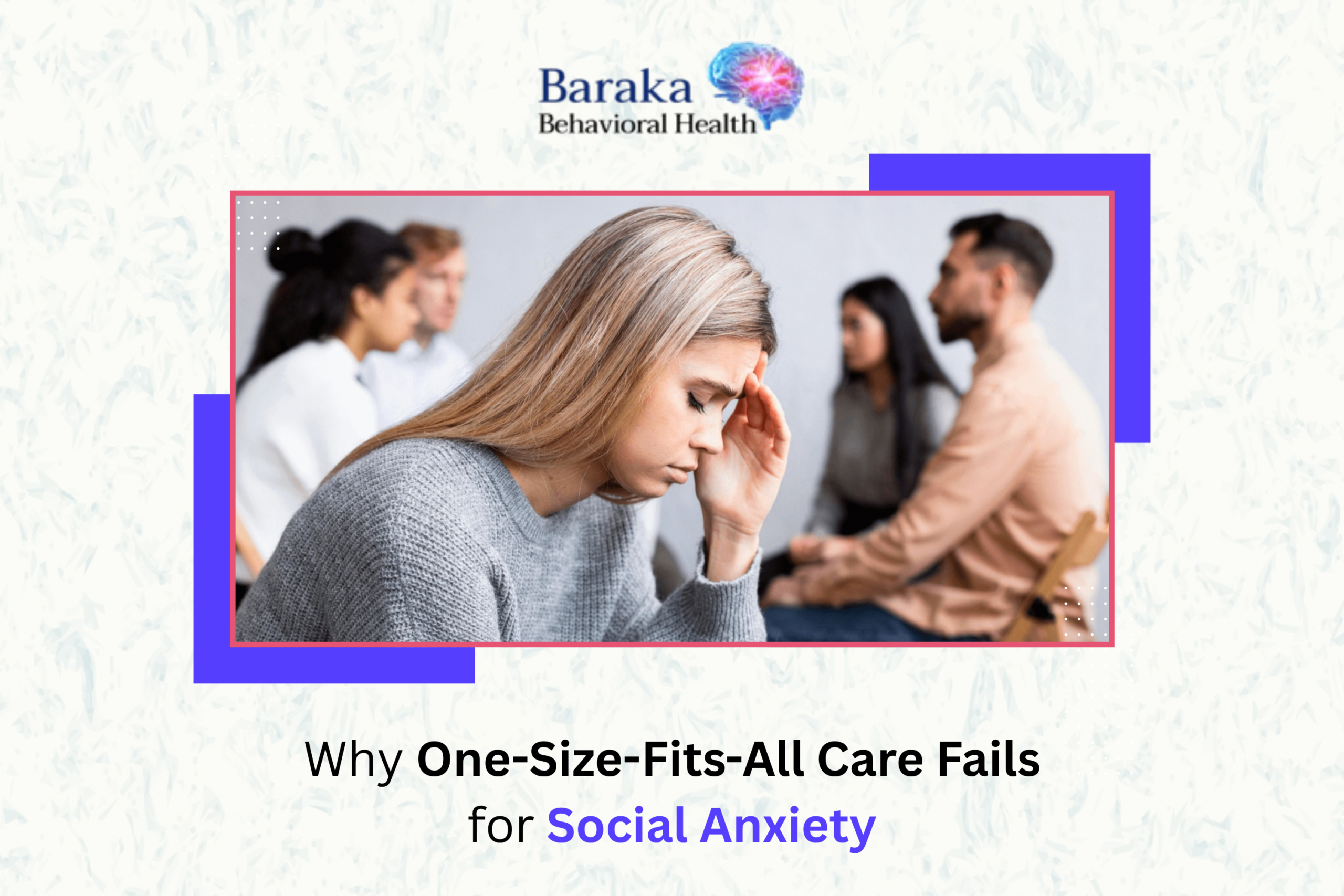
Social anxiety goes beyond just being shy. It’s a deep fear that arises in social situations.
A kid may fear reading aloud. A teen may be anxious about a school event. An adult may fear a job interview. Their heart may pound. Their hands may shake. Their stomach may hurt. They may want to hide.
Many people want help. But sometimes, the help they get does not work well.
Many treatment programs use the same plan for everyone. They treat everyone with social anxiety alike, but each person is different.
Social anxiety care must fit each person.
At Baraka Behavioral Health, we do not use a one-size-fits-all plan. We prioritize personal connection. We make a care plan that fits just them.
Below, we will explain why one-size-fits-all care fails for social anxiety. We will also show why personalized care works much better.
What Is Social Anxiety?
Social anxiety is a health problem. It makes people very scared in social situations. They may worry for days before a party. Common thoughts include:
- “People will laugh at me.”
- “I will embarrass myself.”
- “I won’t know what to say.”
Symptoms of social anxiety can include:
- Feeling hot
- Feeling sick
- Avoiding fun activities
- Staying home
What Is One-Size-Fits-All Care?
One-size-fits-all care means using the same treatment for every person with the same problem. For social anxiety, this might look like:
- Giving everyone the same number of therapy sessions
- Using the same therapy method for all people
- Giving the same medicine to everyone
- Not asking about a person’s own fears or life situation
This plan is fast for clinics. But it does not work well for people with social anxiety. Research shows that only about half of those with social anxiety improve with standard treatments. This means the other half do not receive the help they need.
Why One-Size-Fits-All Care Fails for Social Anxiety?
Every Person’s Fear Is Different
Some people with social anxiety are most afraid of talking to strangers. Others are afraid of eating in front of people. Some are afraid of dating. Others are afraid of job interviews. The fear is not the same for everyone.
A one-size-fits-all plan cannot address all these different fears. It might focus on public speaking when a person is really afraid of making phone calls. It might teach skills that do not match the person’s real life.
People Have Different Life Situations
A young child has a different life than a mom. A person in a small town has a different life than a person in a big city. A person with a supportive family has different needs than someone who feels alone.
Standard care often ignores these differences. It does not ask about a person’s home life, job, school, or money problems. But these things matter a lot for getting better.
Some People Have More Problems
Many people with social anxiety feel sad too. Some have panic attacks. Some use alcohol or drugs to feel calm. Some have bad memories from the past. If care only looks at social anxiety, these other problems stay hidden. Then the person may not get better.
Studies indicate that 30% to 60% of individuals do not respond to traditional treatments. A big reason is that these other problems are not treated. Generic care focuses solely on social anxiety, ignoring the individual as a whole.
Medicine Works Differently for People
Some people take medicine for social anxiety. However, medicine is different from person to person. Some people require a low dose. Others require a higher dosage. Some people have side effects that make them feel worse. Some people are completely opposed to taking medicine.
A one-size-fits-all plan cannot know what each person needs. It may provide too much, too little, or the wrong type entirely.
What Personalized Care Looks Like
Personalized care means the treatment is built around the person. It looks at their story, their fears and their goals. It also looks at what has worked or failed in the past.
A personalized plan may include:
- A full evaluation to understand the person’s unique situation.
- Therapy that fits the person. Cognitive behavioral therapy (CBT) is effective for social anxiety but must be tailored to specific fears.
- Medication when needed. Some require medication to enable them to be calm enough to engage in the therapy work.
- Support for other problems. If the person has depression or panic, the plan also needs to include this.
- A team that listens. The person should feel like a partner in their own care.
At Baraka Behavioral Health, our team offers comprehensive evaluations, structured guidance and consistent follow-up to help people make real progress. We also offer support for children, teens and adults, with options for in-person visits or telehealth.
If you are tired of one-size-fits-all care, we are here for you. We will listen. We will learn about you. We’ll create a personalized plan for you. Don’t suffer social anxiety by yourself. You deserve holistic care.
Why This Matters So Much
Social anxiety can stop people from living. It can stop them from making friends. It can stop them from doing well in school. It can stop them from working. It can stop them from loving. It is not a small problem. It is a big problem that needs real help.
When care fits you, you have a better chance to feel better. You feel acknowledged and valued, which motivates you to continue.
Final Thoughts
One-size-fits-all care fails for social anxiety. People are not all the same. Their fears are different. Their lives are different. Their needs are different. A plan for everyone is a plan for no one.
Personal care works better. It fits you. It treats all of you. It changes when needed. It does not give up. It helps you find hope and help.
Baraka Behavioral Health takes time. We make plans that fit real lives. If you or someone you love is struggling with social anxiety, reach out. We are ready to help you find your path forward.
FAQs
Can social anxiety go away on its own?
It rarely goes away without any help. Talking to an expert can teach you how to beat the fear. Ignoring it can make it grow much bigger over time.
How long does social anxiety take to feel better?
Each person recovers at a different pace. For some, symptoms improve after a couple of weeks. Others need a few long months. The key is to keep trying and follow your personal plan.